
What is Wi-Fi 8 (802.11bn)? When is it coming? And who should care?
If you felt like Wi-Fi 7 just showed up and now the internet is already whispering “Wi-Fi 8”… you are not imagining it. Wi-Fi 8 hardware previews popped up at CES 2026, even though the official standard is still in progress. Now this blog is sort of like a preseason ranking for your favorite sports team; It’s based on reliable information, but there is still a lot to learn about 802.11bn.
Here’s the big twist:
Wi-Fi 8 is not mainly about higher top speed.
It is about better real-world reliability: fewer dropouts, steadier performance at the edge of coverage, and smoother roaming between access points.
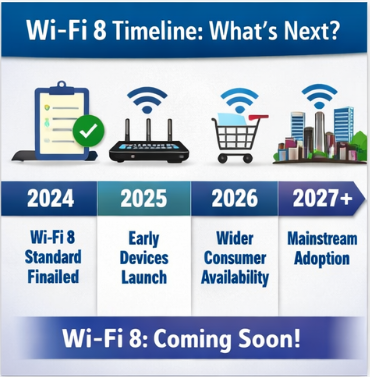
Wi-Fi 8 Timeline: What’s Next?
What is Wi-Fi 8, in plain English?
Think of Wi-Fi generations like cars:
Wi-Fi 6 and 6E made traffic flow better and added new “lanes” (6 GHz).
Wi-Fi 7 pushed crazy peak performance with more advanced techniques.
Wi-Fi 8 is trying to make Wi-Fi feel more like Ethernet in the moments that usually annoy people:
walking around while on a call
busy networks (lots of devices)
weak signal areas (back bedrooms, patios, warehouses)
mesh networks where nodes compete with each other
That “Ethernet-like” goal shows up in the Wi-Fi 8 focus on Ultra High Reliability (UHR)
When can consumers expect Wi-Fi 8 products?
What we know right now (as of January 2026)
Draft-based Wi-Fi 8 gear is already being teased (routers and chip platforms at CES 2026).
Some companies are even saying first devices could launch during 2026, but early gear would be based on draft specs, meaning firmware updates later are likely.
One mainstream timeline cited in industry coverage:
Wi-Fi Alliance certification targeted for January 2028
IEEE final approval targeted for March 2028
The practical expectation for normal buyers
2026–2027: “Early adopter” phase (draft-based, premium, limited choices)
2028+: More “safe” buying window when certification and interoperability testing arrive
After that: mainstream adoption accelerates as client devices catch up (phones, laptops, TVs)
What practical upgrades will you actually feel?
1) Fewer “my Wi-Fi is connected but nothing loads” moments
Wi-Fi 8’s reliability goals reported in coverage include:
about 25% better real-world throughput in challenging signal conditions
about 25% reduction in 95th-percentile latency (this is “worst-case lag,” not average)
about 25% fewer dropped packets, especially while roaming Tom's Hardware
Plain English translation:
smoother video calls while walking around
fewer stutters in streaming
fewer “lag spikes” in gaming
less drama when a device moves between access points (roaming)
2) Mesh systems that act more like a team than a traffic jam
A major theme: multi-AP coordination (access points cooperating instead of competing). Both research and chipset announcements emphasize this direction.
3) Better performance in crowded environments
Apartments, hotels, venues, offices, and “smart homes with everything connected” are where reliability improvements matter more than raw peak speed.
Slightly Nerdy Explanation of the Features Consumers can Expect
Different sources describe the toolbelt a bit differently, but the recurring themes include:
Coordinated Spatial Reuse: smarter sharing of the air so networks waste less time waiting.
Coordinated Beamforming: APs “aim” signal more intelligently, potentially with coordination.
Dynamic Sub-Channel Operation (DSO): use spectrum more flexibly when parts of a channel are noisy.
Multi-AP scheduling/coordination: helpful in dense deployments and mesh.
Also important: coverage notes that Wi-Fi 8 largely keeps the Wi-Fi 7 “ceiling” (same general bands and similar top-end PHY story), but tries to make the real world behave better.
Who Wi-Fi 8 is appropriate for (and who it isn’t)
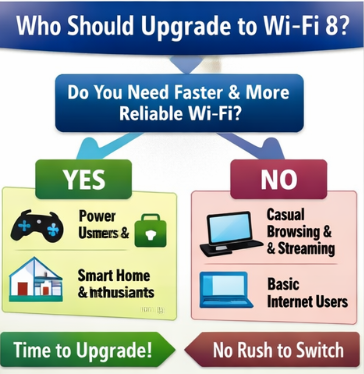
Who Should Upgrade to Wi-Fi 8?
Wi-Fi 8 is a great future fit for:
Homes with mesh systems where consistency matters more than peak speed
Busy networks: lots of phones, TVs, cameras, smart devices
Latency-sensitive users: gamers, streamers, work-from-home video calls
Businesses with mobility: warehouses, clinics, campuses, hospitality
Public venues: high-density guest Wi-Fi, conferences, events
Wi-Fi 8 is probably not worth chasing (yet) if:
You have Wi-Fi 6 or 6E that already feels stable
Your main issue is slow internet from your ISP, not Wi-Fi coverage
You just bought Wi-Fi 7 gear and it’s working well
You are not interested in draft-spec early hardware (which can be real, but comes with “early adopter” caveats).
Will Wi-Fi 8 improve indoor Wi-Fi, outdoor Wi-Fi… or BOTH?
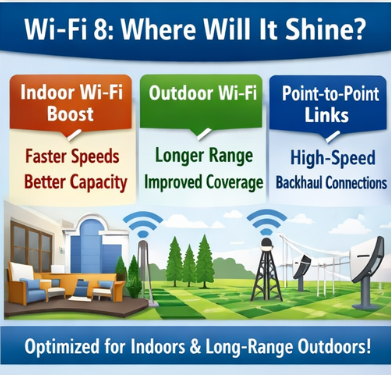
Wi-Fi 8: Where Will it Shine?
Indoor Wi-Fi: yes, this is the main target
Indoor environments are where congestion, roaming, and mesh coordination matter most, so Wi-Fi 8’s reliability focus should show up here first. Tom's Hardware+1
Outdoor Wi-Fi: it can help, but physics still wins
If you use outdoor APs for patios, campgrounds, marinas, RV resorts, or event spaces, “edge of coverage” stability and roaming improvements are relevant. But range is still dominated by:
antenna design and mounting
client device quality (phones are tiny radios)
interference and channel planning
backhaul quality
Wi-Fi 8 helps the behavior of the network. It does not magically turn a bad outdoor design into a good one.
Buying advice: the smart way to approach Wi-Fi 8
If you are planning a network refresh:
If you need results this year
Invest in good design: placement, wiring, PoE switching, proper AP count, proper channel plan.
Consider Wi-Fi 6E or Wi-Fi 7 if you truly need new hardware now.
If you can wait for Wi-Fi 8
Plan for a 2028-ish window if you want “fully certified” confidence.
Watch for client device adoption (phones/laptops) because routers alone do not deliver the full benefit.
-
Wi-Fi 8 is the consumer name for IEEE 802.11bn, designed to prioritize ultra-high reliability, smoother roaming, and better real-world performance rather than chasing huge peak speed increases.
-
Early draft-based products are being previewed in 2026, while industry coverage points to Wi-Fi Alliance certification around January 2028 and IEEE final approval around March 2028.
-
The focus is less on higher peak speed and more on stability, lower latency spikes, and better performance in weak-signal or congested environments.
Wi-Fi 8 is shaping up to be the most “real life” Wi-Fi upgrade in a while. Not because your speed test number doubles, but because your Wi-Fi stops acting weird at the worst possible times.
If you want help deciding whether you should upgrade now (Wi-Fi 6E/7) or plan for Wi-Fi 8 later, the fastest win is usually a real network review: coverage map, interference scan, AP placement plan, and backhaul check.
Contact us today for more information!
👉770-781-4787 or sales@interstatenetworks.com
➡️Related posts: