
RF 101: A Practical Introduction to Radio Frequency (RF)
Radio frequency, often shortened to RF, is the foundation of nearly every modern wireless technology. Wi Fi, cellular networks, two way radios, wireless bridges, and even broadcast radio all rely on RF to function. Yet for something so critical, RF is often poorly understood or misunderstood altogether.
This guide is designed to demystify radio frequency. We will cover what RF is, how frequencies are measured, how Wi Fi and cellular differ, how regulations shape wireless deployments, and why channel width and interference matter so much in real world networks.
What Is Radio Frequency (RF)?
Radio frequency is a portion of the electromagnetic spectrum used to transmit information wirelessly. Instead of data traveling through a physical cable, it is encoded into electromagnetic waves that move through the air.
RF is used everywhere, including:
AM and FM radio
Television broadcasts
Emergency and public safety communications
Wi Fi and Bluetooth
Cellular networks
Point to point wireless links
Every wireless system operates within a defined range of frequencies, and those ranges determine how far signals travel, how much data they can carry, and how susceptible they are to interference.
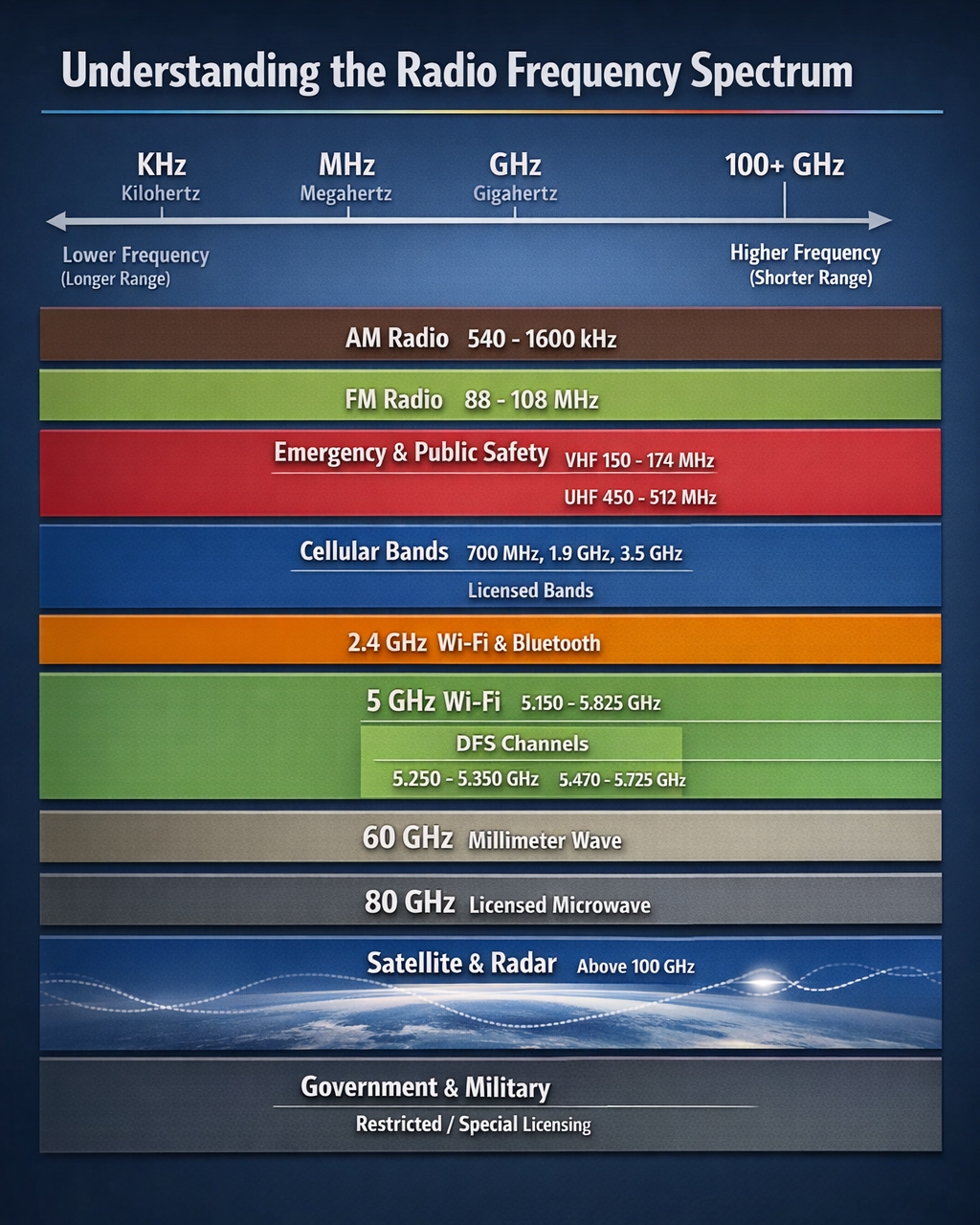
Understanding the Radio Frequency Spectrum
Hertz, Megahertz, and Gigahertz Explained
RF is measured in hertz, which simply means cycles per second.
Here is how the units scale:
1 hertz equals one cycle per second
1 megahertz equals 1,000,000 cycles per second
1 gigahertz equals 1,000,000,000 cycles per second
Another helpful way to think about it:
1 GHz equals 1,000 MHz
So when you hear that Wi Fi operates at 5 GHz, that means it is operating at 5,000 MHz. The terminology changes, but the math does not.
Higher frequencies generally support faster data rates but tend to travel shorter distances and have a harder time passing through walls or obstacles. Lower frequencies travel farther and penetrate better, but they carry less data.
5 GHz vs 5G: Two Very Different Things
One of the most common sources of confusion in wireless technology is the similarity between 5 GHz and 5G. Despite how they sound, they are not the same thing.
5 GHz refers to a specific frequency band commonly used for Wi Fi.
5G refers to fifth generation cellular technology. It is a standard, not a frequency. 5G can operate across many different frequency ranges, including low band, mid band, and very high millimeter wave frequencies.
In short:
5 GHz is a Wi Fi frequency band
5G is a cellular technology standard
They both use RF, but they are designed for very different purposes.
Channel Width: Speed vs Stability
Operating in a frequency band is only part of the story. Within that band, wireless devices transmit using channels, and those channels can have different widths.
For example, a 5 GHz Wi Fi access point can use:
20 MHz channels
40 MHz channels
80 MHz channels
160 MHz channels
Wider channels allow more data to pass through at once, which means higher speeds. However, wider channels also consume more of the available spectrum, increasing the likelihood of interference with other devices.
This same principle applies beyond Wi Fi. In cellular marketing, terms like ultra wideband are describing the use of very wide channels to achieve extremely high speeds.
The tradeoff is always the same:
Wider channels equal more speed
Narrower channels equal more stability and less interference
Choosing the right channel width depends on the environment, the number of devices, and how crowded the RF space is.
Interference: When Signals Collide
Interference happens when two or more devices attempt to transmit on the same frequency space at the same time and at similar signal levels.
A simple example is a two way radio. Only one person can speak at a time. If both people press the button and talk simultaneously, neither message is understood. That is why radio users say “over” at the end of a transmission, signaling that the channel is clear.
Wireless networks behave the same way. When devices talk over each other, performance drops, retries increase, and connections become unreliable. Wider channels increase the risk of overlap, which is why careful RF planning is critical in dense environments.
Managing interference is one of the most important aspects of professional wireless design.
The Role of the FCC and Global Regulators
In the United States, the Federal Communications Commission governs how radio frequencies are allocated and used. The FCC defines:
Which frequency bands are licensed
Which bands are unlicensed
Power limits and technical rules for each band
Special protections for services like radar and emergency systems
Other countries have their own regulatory bodies, but the concept is the same worldwide. RF is a shared resource, and it must be managed to prevent harmful interference.
Compliance with these regulations is not optional. Proper design ensures performance, reliability, and legal operation.
DFS Channels and Radar Protection
Dynamic Frequency Selection, or DFS, applies to certain 5 GHz Wi Fi channels that are shared with radar systems such as weather radar and military installations.
When a Wi Fi device uses a DFS channel, it must monitor for radar signals. If radar is detected, the device must immediately stop using that channel and move to another one.
DFS channels can be extremely useful because they are often less crowded, but they are not always appropriate. In areas near airports, military bases, or weather radar, DFS channels may become unusable due to frequent forced channel changes.
Knowing when and where to use DFS channels is another example of why RF expertise matters.
Bringing It All Together
Radio frequency is not magic. It is physics, regulation, and careful engineering working together. Understanding frequency ranges, channel widths, interference, and regulatory rules leads to better performance and fewer problems.
This is exactly why professional wireless design is so important. The airwaves are shared, limited, and unforgiving when misused.
Continue Learning About RF
If this introduction was helpful, there is much more to explore. Be sure to check out our other RF focused resources, including:
A deep dive into 60 GHz wireless technology
An overview of dual band Wi Fi design
A look at Wi Fi 7 and the 6 GHz spectrum
Each of these topics builds on the fundamentals covered here and shows how RF choices directly impact real world networks.
If you have questions about wireless performance, design, or deployment, our team is always happy to help.
Contact us today for more information!
👉770-781-4787 or sales@interstatenetworks.com
➡️Related posts: